The Importance of Walking the Talk
To effectively introduce the Enterprise Maturity topic and ensure it resonates with teams in a practical way, I often begin with a relatable story that sets the stage for our conceptual discussions. The following is one example story in the library …
While eating lunch with my team in the company cafeteria, I recall watching our very animated CEO being interviewed by CNBC at the World Economic Forum in Davos. The interview was fascinating, and our CEO was both visionary and immensely engaging when sharing what our organization was focused on.

Heck, the message my CEO was evangelizing was great! If I had not been part of the organization already, I would have signed up immediately!
Unfortunately, and much to my surprise, discomfort, and dismay, when comparing my personal experience of the company, as well as the corporate messaging I had been receiving, I did not recognize an awful lot of what our CEO shared with the CNBC news anchor that day – suffice to say, as a leader responsible for a small team myself, I found this profoundly troubling at the time.
While I found the CEO’s vision and interview compelling listening, I was incredibly disturbed by the degree of disconnect between what I heard during the interview and my lived experience. What my CEO talked about bared little resemblance to the business that I had operated in for just over 3-years.
The disconnect that I experienced is much more common than many executives realize – it is incredibly demoralizing for a workforce and a significant threat. If the corporate messaging does not congruently align with the organization’s investment in capability – aka investment in people, process, systems, infrastructure, technology etc. – successful execution will remain out of grasp.
Throughout my career I have seen this very same misalignment in business’ of all shapes and size, both established corporate blue-chips and start-ups alike. It is this painful lived experience that inspired the creation of the Enterprise Maturity Roadmapping approach, which I will elaborate on later in this chapter.
When translating strategy into meaningful execution, a fundamental question we need to ask frequently is “how do we know when we will get there?” It is no good having a great sounding corporate vision if the vision does not connect strategic intent and direction to capability investment and future outcomes. To clearly understand whether ‘everyone is walking in the same direction’, I advise you to take an enterprise-wide look at what the organization is doing, rather than saying.
A good start would be to take a good look at the previous two years investment in people, capability, and capacity.
Assessing Corporate Alignment (Mine-Sweeping Process)
One of the first exercises that I get my teams to carry out involves looking at the maturity investment profile over the previous 2-years and comparing this with the stated strategic intent to assess the degree of alignment between investments and business priorities. This activity helped the business understand the extent that we were ‘doing the right projects and doing the projects right’.
At Deep-Tech, the recently appointed Head of Change and PMO coordinated the alignment assessment exercise. He was also tasked to conduct a comprehensive audit of any and all key performance metrics/indicators (KPI) and objectives and key results (OKR’s) in use across the business.
Taking a clear-eyed view on the KPI and OKR’s currently in use allowed us to assess and test the extent of the existing corporate grip – including understanding what is and is not monitored and the related gaps or blind spots. As the saying goes, what gets measured gets done.
By gathering and assessing the key metrics, we can determine what’s working, what’s not working, and what’s missing – we can similarly understand what performance is seen, not seen and completely off the performance radar. This activity contributed to our paving the way to ensuring the business focused on and measured the right things to stay on track and achieve its priorities.
When developing a corporate maturity roadmap, the capability/project investment sequencing is often overlooked. Too often, the loudest, most influential voice gets its way with a significant, costly investment that is not urgently required and at the expense of more urgently required capability investment.
The metaphor of “building your own house while living in it” is a great way to illustrate this problem. If you lived in your house while it was being constructed simultaneously, you would likely not invest in installing an outdoor pool and landscaping your garden first. With utility and comfort as your top priorities, you would likely focus on building the roof and walls to stay dry and warm and installing the toilet, bedroom, and kitchen. This simple concept is no different for any transformation, regardless of size or complexity.
Crafting the Enterprise Maturity Roadmap
An Enterprise Maturity Roadmap is a strategic blueprint that outlines an organization’s journey toward achieving maturity and excellence in its operations, products, and services. It provides a clear progression path, guiding the organization through distinct stages of its development.
Experience has taught me that the most effective way to build a fit for purpose corporate maturity roadmap, is to involve a select group of the right people to collaboratively work through, test and agree the key milestone investments that put the required enterprise capacity and capability in place.
While at AllChange Strategic Consulting, we developed a collaborative corporate maturity roadmapping approach. This approach, called Outcomes Capability Modelling, ensured that the right capability investments were selected and carried out in the best sequence for the business.
The Outcomes Capability Model is a proven methodology designed to create a coherent investment strategy within a common roadmap framework everyone can understand. This methodology explicitly connects strategic intent to project delivery, ensuring optimal resource allocation while aligning business efforts with short, medium, and long-term goals.
The image below outlines the roadmapping process. It also demonstrates how this process integrates with the development activities of the Target Operating Model.

Outcomes Capability Model
The Outcomes Capability activity is carried out via a series of iterative workshops. In the lead up to the first workshop, key participants are identified and handed preparation homework to carry out in readiness for this activity.
Pre-Workshop Preparation
The preparation activity included:
- A team briefing including activity scope highlighting the activity purpose, objectives and targeted outputs, so everyone clearly understood why the activity was being held.
- An individual briefing clarifying why each participant had been selected, what their contribution would be, and detailed explanation of the individual preparation required. The participant guidance mapped directly to the planned workshop activities and was intended to ensure everyone turned up with pre-prepared thinking and ideas ready to hand; and
- An Exec Summary Discovery report that presents the consolidated findings from the assessment exercise overseen by the Head of Change and PMO (i.e., the corporate alignment and measurement activity mentioned at the top of this chapter).
Workshop 1 – Collaboratively Modeling the Thinking
Workshop 1 kicked-off with a scene setting activity that explained why we were here, what the objectives were, and why the day was taking an outcome-based thinking approach.
Why Outcomes & this Approach?
Stephen Covey, a respected educator and author on business performance, introduced the concept of “beginning with the end in mind.” This concept highlights the importance of starting any endeavor by first envisioning the desired end state.
By doing so, we set a clear, purposeful direction guiding our actions and decisions. This approach encourages us to align our efforts with long-term goals, ensuring that we can make meaningful progress while being able to adjust our course to stay on track.
Every decision in a business, from the strategies devised in boardrooms to the daily tasks of individual contributors, has an associated outcome. However, not all decisions are created equal. Some lead to tangible, positive results, while others might have negligible or even negative effects. Hence, it’s crucial to shift our focus from merely making decisions to making decisions based on the potential outcomes.
The workshop approach was designed to foster a shared understanding of the desired outcomes, and through rigorous exploratory debate, enable the participant group to settle on a consensus view going forward. Workshop 1 was the team’s first step in this highly collaborative initiative …
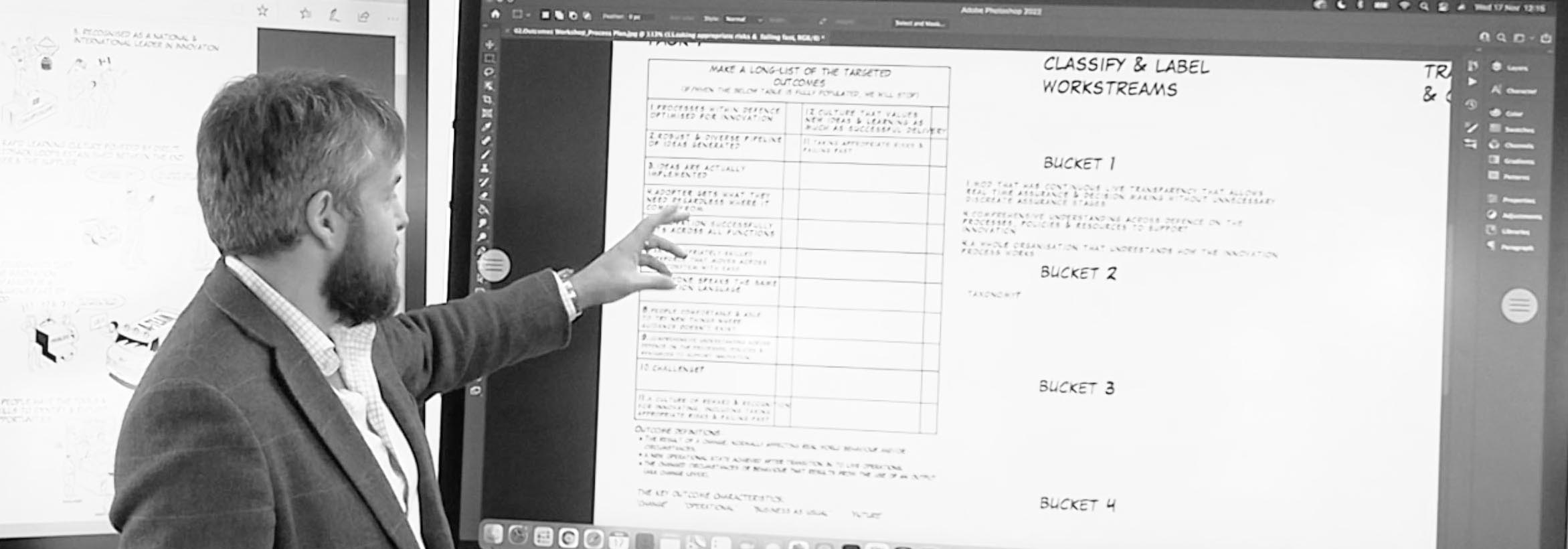
The remainder of the Enterprise Maturity Roadmap development process is thoroughly examined in the book “Transformative.” The process illustrated in the image above, is unpacked and explained in great detail, featuring real workshop photos that showcase the collaborative approach deployed throughout the workshop activity.
Source: Excerpt from Transformative, Author Ian Ure.