Ambition is common. Execution that holds is rare.
We restore execution coherence across complex organizations – eliminating decision drift, accelerating delivery, and protecting enterprise value before transformation stalls.
£45m+ value unlocked | 50-70% faster execution cycles | 20-30% reduction in rework
When leadership, delivery, and operations move out of sync, transformation stalls, costs rise, and accountability disappears. We restore execution control.
Financial Services • Technology • Defence • Government • Engineering • Energy
We’re called when execution starts to break
Delivery Drift
Strategy is set. Delivery is not holding.
Decisions stall. Momentum is fading.
Leadership misalignment is creating drag.
Scaling Pressure
Growth is outpacing the operating model capacity.
Cost must come out without breaking delivery.
A critical event must land – and cannot fail.
AI investment is not delivering measurable value.
Transformation Risk
Transformation spend is not producing results.
Integration must deliver promised value.
Performance must improve – quickly.
We’re brought in when complexity overwhelms, grip slips, change stalls, or direction drifts – restoring control, clarity, and momentum fast.
WHY EXECUTION BREAKS
Execution breaks when decisions don’t hold through delivery.
Direction fragments. Ownership blurs. Momentum slows.
We establish clear direction and align execution from leadership through delivery.
FROM DRIFT → TO CONTROLLED EXECUTION
Before…
- Conflicting priorities
- Delays and churn
- Repeated decisions
- Delivery drift
After…
- One clear direction
- Controlled execution
- Faster delivery
- Accountability is clear
HOW WE TURN DECISIONS INTO EXECUTION
1. Diagnose with evidence
Evidence before opinion. Expose friction, risk, blocked momentum – as well as opportunity
2. Align leadership to one direction
One set of priorities, owners, and trade-offs
3. Build the control spine that holds execution
Install governance, cadence, decisions, transparency and accountability
4. Mobilise delivery as one system
Run teams, partners, governance, and technology as one coordinated system
5. Maintain execution control at pace
Embed capability, rhythm, and measurable gains
We install the leadership operating system that ensures the enterprise moves as one.
HOW WE RESTORE CONTROL & EXECUTION
We are brought into complex enterprise environments when execution begins to fragment under pressure – priorities collide, momentum slows, direction drifts, and leadership alignment becomes critical to restoring control, clarity, and coordinated delivery.
We work directly alongside leadership to expose execution friction, restore decision clarity, strengthen governance, and mobilize coordinated delivery at pace.
We install the control structure that allows strategy to hold through execution – aligning priorities, ownership, accountability, delivery rhythm and operational decision‑making across the enterprise.
Each engagement is designed to navigate complexity, stabilize momentum, reduce delivery drift, and create measurable execution confidence under real operating conditions.
Enabled through our Enterprise Decision Spine™ – the closed‑loop enterprise execution system that converts strategic intent into aligned, governed, measurable delivery that holds under pressure.
Diagnose & Discover
Rapid Diagnostic Sprint
Best for: Stalled delivery, unclear blockers
Expose friction, risk, and blocked momentum in 2 weeks – pinpointing where execution is breaking and what to do next
Enterprise Value Discovery
Best for: When value is unclear, fragmented, or not translating into results
Expose where value is created, lost, and constrained – prioritizing the few levers that will unlock the greatest return and defining where to act with immediate impact
AI Workflow Sprint
Best for: Identifying high-ROI AI opportunities
Service blueprinting and user journeys to identify, focus, and validate high-ROI AI use cases with clear commercial impact
Decide, Define & Execute
Enterprise Advantage
Best for: When direction is unclear, contested, or needs to be established fast
Force clarity on enterprise position, resolve critical trade-offs, and converge leadership rapidly on a decision-ready position that holds under pressure – compressing months of debate into days.
12-Week Change Strategy
Best for: Need for clarity, alignment, mandate, and direction
Define and formalize the enterprise mandate – aligning leadership on position, priorities, and an executable path that governs execution and investment across the enterprise within 12 weeks
Transformation Recovery
Best for: Drifting or high-pressure transformation programs
Stabilize delivery, restore delivery control, and recover pace through specialist, turnkey interventions – bringing critical initiatives back on track fast
Decide once. Apply everywhere. Execute without drift.
OPERATING ENVIRONMENTS
Multi-division enterprises • Regulated environments • High-pressure transformation environments • Cross-functional delivery recovery • Enterprise AI adoption • Complex governance structures • Time-critical execution mandates
PROVEN IMPACT IN COMPLEX ENVIRONMENTS
When decisions hold, execution accelerates – and value is unlocked at pace.
£45m+
value delivered within 12 months
Restored enterprise alignment across six divisions operating through fragmented governance, competing priorities, and delivery drift – accelerating execution and unlocking measurable value as part of exit readiness
Within 12-weeks, program governance across six divisions was re-established and investment decisions were brought back under executive control.
50–70%
faster execution cycles
Compressed months of stalled coordination into aligned delivery by establishing clear decision ownership, governance cadence, and enterprise-wide execution rhythm
20–30%
reduction in rework
Reduced duplication, conflicting decisions, and operational drag across cross-functional delivery teams through disciplined execution control
We’re brought in when the problem is complex, the stakes are high, and leadership alignment is critical – restoring clarity, convergence, and coordinated action fast.
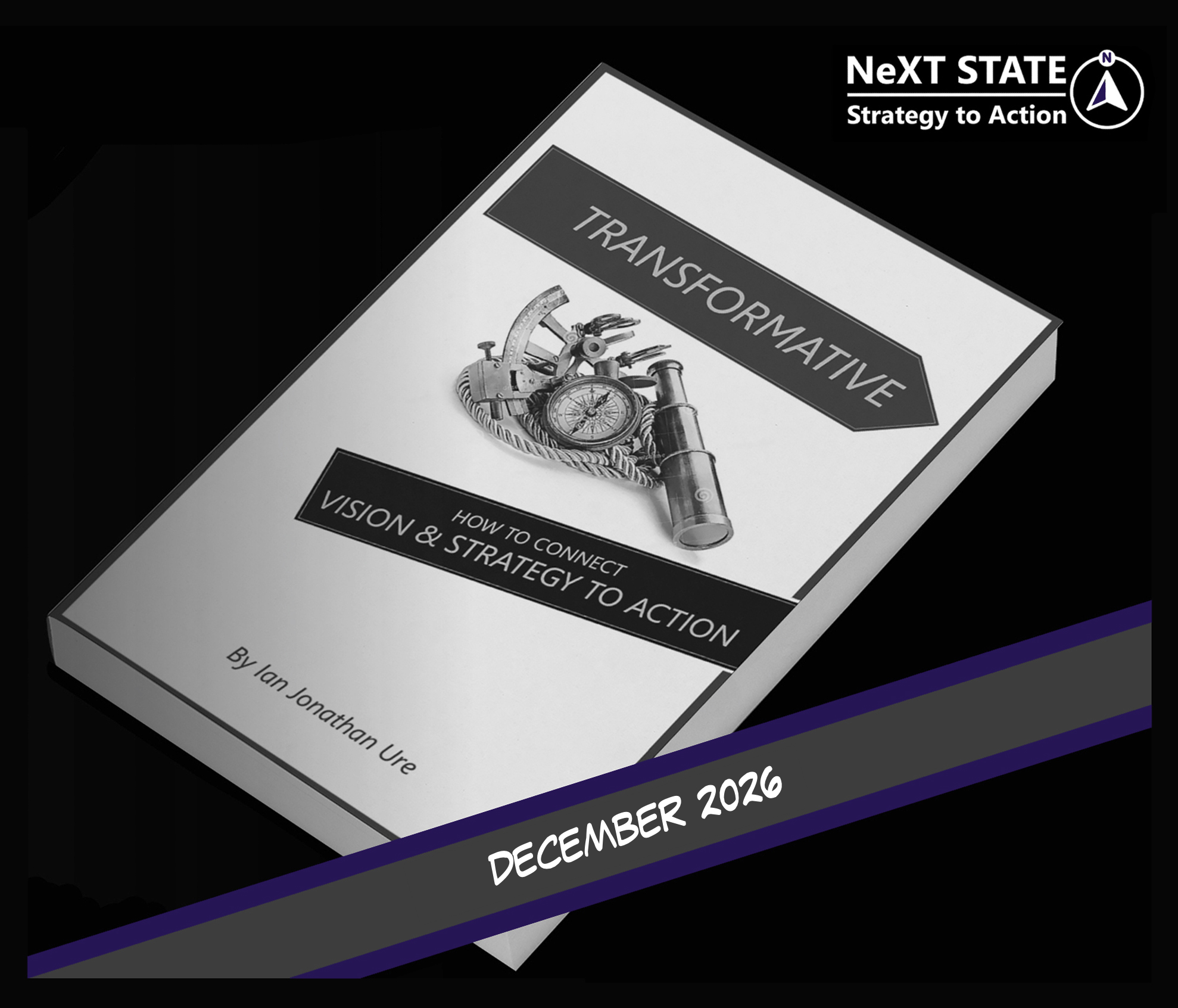
Transformative
How to Connect Vision & Strategy to Action
Author: Ian Ure
In the book “Transformative,” Ian Ure introduces his Leadership Operating System, a detailed conceptual and practical framework that effectively links vision and strategy to frontline execution. This innovative and proven approach aims to drive performance improvement and facilitate meaningful organizational and technological change, as well as foster creativity and innovation – all ultimately leading to enhanced business value creation.
The Leadership Operating System is built upon decades of hands-on frontline experience. Just as a Computer Operating System has three functions…

To Control All Execution

To Direct Resources

To Reduce Complexity
…the Leadership Operating System’s function is to provide a guiding handrail for execution: to direct and coordinate teams and resources; to reduce complexity; and to remove roadblocks that impede implementation.
The System is specifically designed to deliver coherence and shared understanding across all grades and tiers of the organization. To find out more, click on the adjacent button.